Concurrency Hazards: Livelock, Starvation, and Priority Inversion
Explore the spectrum of concurrent failure modes. Contrast CPU-burning livelock with blocking deadlocks, study scheduling starvation, and analyze Priority Inheritance Protocols (PIP) using the Mars Pathfinder anomaly.
1. The Spectrum of Concurrency Hazards
When designing concurrent multithreaded systems, preventing race conditions via mutexes and semaphores is only the first hurdle. Even when mutual exclusion is correctly implemented, thread interactions can lead to systemic operational failures where tasks fail to make forward progress.
Operating systems theory classifies these failures into three distinct concurrency hazards: Deadlock, Livelock, and Starvation. While superficially similar because all three prevent threads from completing, their underlying microarchitectural mechanics and CPU utilization profiles are fundamentally different.
| Hazard Type | Thread Execution State | CPU Utilization | Root System Cause | Remediation Strategy |
|---|---|---|---|---|
| Deadlock | Blocked / Sleeping (TASK_UNINTERRUPTIBLE) | 0% (Zero Burn) | Simultaneous satisfaction of the Four Coffman Conditions. | Lock ordering, Banker's Algorithm, or process termination. |
| Livelock | Active / Running (Executing instructions continuously) | 100% (Busy Waiting / Burn) | Overly polite error-recovery logic causing continuous state oscillation. | Randomized exponential backoff or lock relinquishment jitter. |
| Starvation | Ready / Runnable (Willing to run, but bypassed by scheduler) | Near 0% (For starved thread) | Unfair scheduling heuristics prioritizing high-priority threads indefinitely. | Aging algorithms, priority boosting, and fair queueing (CFS). |
Detailed Mechanics of Livelock
Livelock occurs when two or more processes continuously change their internal states in response to changes in the other processes without doing any useful work. The classic real-world analogue is two polite people walking toward each other in a narrow corridor: both step to the left at the same time, then both step to the right at the same time, blocking each other indefinitely while actively moving back and forth.
Unlike deadlocked threads that yield the CPU and sleep, livelocked threads are fully active. A thread caught in a livelock executes lock acquisition attempts, fails due to contention, catches the failure exception, yields or backs off briefly, and immediately loops to retry. The OS scheduler continuously schedules these threads because they remain in the RUNNABLE state, driving core CPU utilization to 100% while accomplishing zero computational progress.
Real-World Architectural Examples of Livelock
- Network Collision Backoff Livelock: In decentralized Ethernet or wireless collision domains, if two nodes transmit packets simultaneously, a collision occurs. If both nodes implement deterministic backoff algorithms (waiting an identical fixed interval before retransmitting), they will collide again in lockstep, oscillating forever between transmission and collision states. Defense: Implementing randomized exponential backoff (e.g., Ethernet CSMA/CD).
- Optimistic Concurrency Control (OCC) Database Livelock: In database management systems utilizing optimistic locking, two transactions read the same record, compute modifications, and attempt to commit. The DBMS validates that neither record was modified in the interim. Finding a conflict, the DBMS aborts Transaction A, rolls back, and restarts it. Simultaneously, Transaction B aborts, rolls back, and restarts. If their execution cadences overlap perfectly, they will abort and restart each other in an infinite livelock loop.
2. Priority Inversion and The Mars Pathfinder Anomaly
Priority inversion represents one of the most insidious architectural failures in preemptive priority-based operating systems. It occurs when a high-priority task is indirectly delayed or preempted by a lower-priority task, subverting the core scheduling contract.
1. The Three-Task Dependency Chain & Execution Timeline
The classical priority inversion scenario involves three concurrent threads or tasks operating across disparate static priority levels (P_High > P_Medium > P_Low). To fully understand why this creates a systemic vulnerability, we must trace the precise microarchitectural interactions between the OS scheduler's runqueue, CPU register contexts, and mutex wait queues step by step across a strict chronological timeline:
-
T0 (Mutex Lock Acquisition):
The low-priority task (
P_Low) is scheduled by the kernel, enters its designated critical section, and successfully acquires mutual exclusion lockMprotecting a shared resource (e.g., hardware bus registers). While executing inside the critical section, its time slice elapses or an asynchronous event occurs. -
T1 (Medium-Priority Preemption):
An unrelated medium-priority task (
P_Medium) becomes runnable (triggered by an I/O completion or network packet). BecauseP_Medium > P_Low, the OS scheduler immediately preemptsP_Low, saves its register context to its Thread Control Block (TCB), and placesP_Mediumonto the active CPU runqueue.
Crucial State:P_Lowis suspended mid-critical section while actively holding lockM. -
T2 (High-Priority Blockade):
A critical high-priority task (
P_High) wakes up to process time-sensitive data. BecauseP_High > P_Medium, the scheduler preemptsP_Mediumand allocates the CPU toP_High.P_Highbegins execution, but immediately encounters a synchronization barrier when attempting to acquire lockM.
Per kernel synchronization semantics,P_Highis blocked (moved from the active runqueue to lockM's wait queue), and a context switch returns the CPU back toP_Medium. -
T3 (The Inversion Lockup):
P_Mediumresumes execution on the CPU. BecauseP_Highis blocked waiting for lockM, andP_Lowcannot be scheduled becauseP_Mediumoutranks it,P_Mediumruns continuously.P_Lowremains starved of CPU time and cannot finish its critical section to release lockM. -
T4 (The Scheduling Contract Violation):
The system reaches a state where
P_Medium(medium priority) executes indefinitely ahead ofP_High(high priority). The nominal priority ordering is completely inverted in practice, violating real-time execution guarantees.
This microarchitectural dead-end exposes a foundational flaw in naive priority schedulers: static priority checks are completely blind to dynamic data dependencies managed through synchronization primitives. Without runtime feedback mechanisms, intermediate tasks can inadvertently starve critical operations for arbitrary durations.
Nominal Priority Ordering:
P_High > P_Medium > P_Low
Effective Execution Order under Inversion:
P_Medium runs while P_High starves
2. The Mars Pathfinder Priority Inversion Anomaly (July 1997)

Days after landing successfully on the Martian surface in July 1997, the Mars Pathfinder spacecraft—running the VxWorks preemptive priority-based real-time operating system—began experiencing sporadic, unexplained total system resets. While no scientific or telemetry data was permanently lost, each reset triggered a hard reboot that suspended data collection and delayed daily rover operations for hours.
Contrary to dramatic popular accounts portraying the spacecraft as moments from catastrophic destruction, Pathfinder was functioning precisely as its defensive systems engineering intended. Its onboard watchdog timer noticed that core software tasks were stalling and executed clean reboots to clear the digital jam. However, isolating the root cause required forensic analysis of a classic priority inversion trap.
Architectural Context & The Information Bus
Pathfinder utilized an internal "information bus"—a shared memory and communication region used to pass telemetry and sensor data between disparate instrument subsystems and lander components. Access to this bus was strictly synchronized using mutual exclusion semaphores (mutexes) to prevent race conditions during concurrent reads and writes.
Three specific software tasks interacted across competing priority levels:
-
The Meteorological Task (
P_Low/L): An infrequent, low-priority background thread responsible for gathering atmospheric pressure, temperature, and wind data. When publishing its telemetry records, it acquired the information bus mutex, performed memory writes, and released the mutex. -
The Communications & Science Data Task (
P_Medium/M): A heavy, medium-priority task handling continuous background data formatting and radio transmission streams. Because it did not require the information bus mutex, it had no synchronization dependencies onL. -
The Information Bus Management Task (
P_High/H): A critical, high-priority thread that ran frequently to move time-sensitive guidance and instrument data in and out of the information bus. It required frequent acquisition of the information bus mutex.
The Failure Cascade & Watchdog Trigger
The anomalous execution sequence unfolded through an unfortunate alignment of task cadences:
-
Step 1 (Mutex Lock): The low-priority meteorological task (
L) scheduled and acquired the information bus mutex to write atmospheric sensor data. -
Step 2 (Preemption): Before
Lcould finish its writes and release the mutex, an interrupt triggered the medium-priority communications task (M). BecauseM > L, the scheduler preemptedLand allocated the CPU toM.Lremained suspended mid-critical section while holding the bus mutex. -
Step 3 (High-Priority Blockade): The high-priority information bus task (
H) became runnable. BecauseH > M, the scheduler preemptedMand gave the CPU toH.Hattempted to read the information bus, encountered the mutex held byL, and blocked—waiting forLto release it. -
Step 4 (Starvation & System Reset): Control returned to
M(the medium-priority task) becauseHwas blocked andLwas suppressed.Mran continuously, starvingLof any CPU time. BecauseLcould never run, it could never release the mutex.Hremained blocked indefinitely.
After a predetermined duration, the spacecraft's hardware watchdog timer noticed that the high-priority bus management task (H) had failed to check in within its mandated execution window. Assuming a fatal software deadlock or hardware lockup, the watchdog issued a hard reset command, rebooting the lander safely.
Debugging on Earth & The Remote Patch (The PIP Solution)
Back at NASA's Jet Propulsion Laboratory (JPL), engineers recreated the exact mission workload on a spacecraft replica rig in their lab with kernel event tracing enabled. After hours of tracing, an engineer running tests late into the night reproduced the system reset, confirming the priority inversion deadlock.
The solution implemented was the Priority Inheritance Protocol (PIP). VxWorks mutex objects accept an initialization parameter determining whether priority inheritance should be enforced. When created, this parameter had been left disabled (set to FALSE) for performance optimization.
Rather than attempting to recompile and re-flash the flight software stack across 100 million miles of interplanetary space, JPL engineers exploited a built-in feature: VxWorks included an online C language interpreter compiled directly into the launch image for debugging. Because the initialization symbols were preserved in the spacecraft's global symbol table, engineers uploaded a short C script that changed the mutex configuration variables from FALSE to TRUE.
Once priority inheritance was active, whenever high-priority task H blocked on the mutex held by L, the kernel temporarily elevated L's priority to match H. This prevented medium-priority task M from preempting L, allowing L to finish its critical section immediately, release the mutex, and unblock H. Zero further system resets occurred for the remainder of the mission.
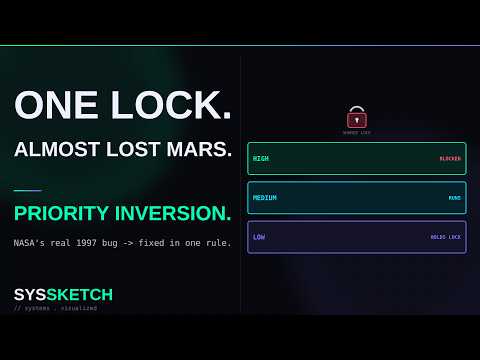
Visual Walkthrough — Priority Inversion & Mars Pathfinder Analysis: