Week 1 Overview Hub
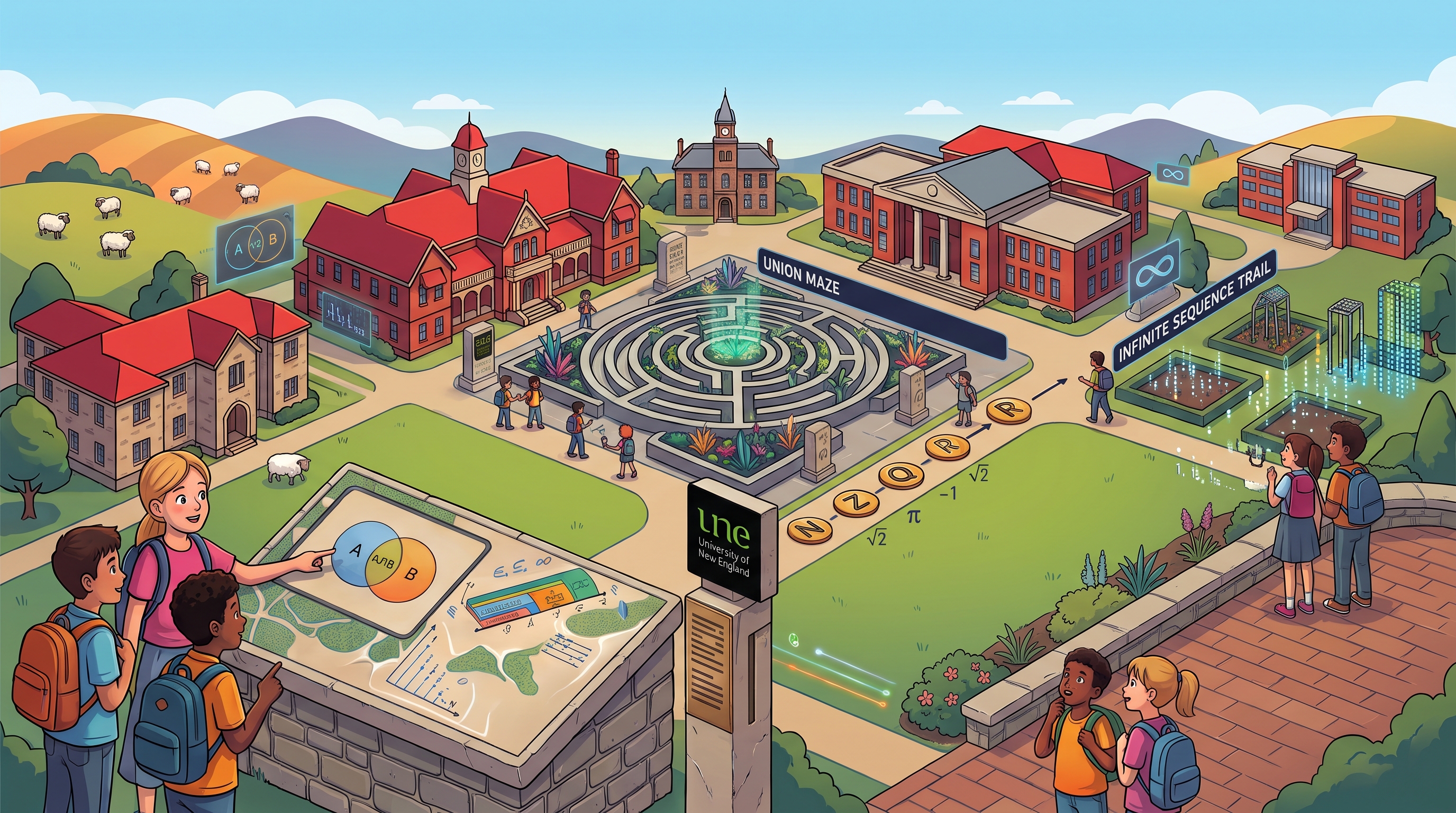
How Irrational Numbers Forced Real Analysis
AI Overview discussion on the Pythagorean crisis, incommensurability, and the foundational need for the real continuum.
Weekly Lecture Modules
Transitioning from computational calculus to formal analysis can feel like learning a completely new language. In earlier courses, you learned how to calculate answers; here, we explore why those calculations hold true and how to construct airtight proofs from the ground up.
Because rebuilding your mathematical foundation from first principles is conceptually demanding, Week 1 is deliberately broken into three progressive stages. Rather than rushing straight into limits, each lecture focuses on mastering one layer of the foundation before building the next:
Sets, Operations, Functions, and Peano's Foundations →
Build your confidence with the formal language of pure mathematics. Rather than memorizing formulas, we explore how sets clarify mathematical statements, demystify what functions actually do beneath the surface, and take a look behind the scenes at how the counting numbers are built from scratch.
Number Systems, Metric Properties, and Completeness →
Uncover why fractions alone cannot capture every point on the number line. We look at the classic argument showing why numbers like $\sqrt{2}$ cannot be written as simple fractions, introduce intuitive geometric tools for measuring distance, and see how the real numbers provide a seamless, gap-free continuum for the calculus ahead.
Sequences, Differences, and Sums →
See how simple lists open the door to limits. We explore sequences both as everyday ordered lists and as functions on the counting numbers, use visual tools to observe how their long-term behavior unfolds, and discover clever algebraic patterns—like telescoping sums and Gauss's formula—that make large calculations surprisingly clean.