MTHS120: Study Notes & Interactive Modules
A companion guide to real analysis—designed to build your mathematical intuition through clear explanations, interactive visuals, and step-by-step proofs.
Welcome to the Journey! 📐
Mathematics is not a collection of disconnected recipes—it is a continuous landscape of ideas connecting the discrete to the smooth, the static to the dynamic, and individual equations to multidimensional spaces.
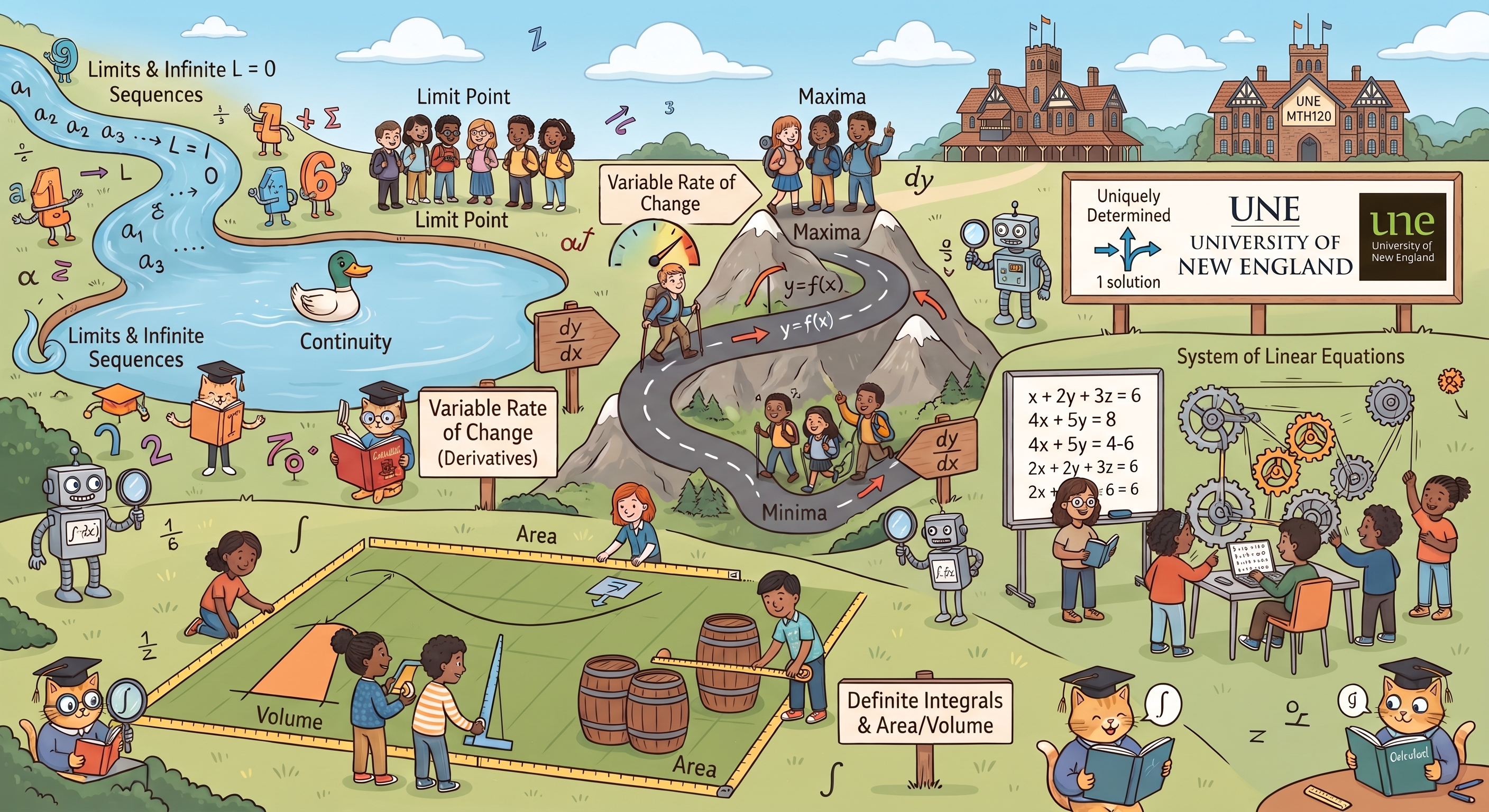
Welcome! Whether you are meeting formal proofs for the first time or revisiting calculus from a rigorous perspective, this companion is designed to walk alongside you every step of the way. You won't have to navigate abstract concepts alone: each module breaks down complex ideas into intuitive visual steps, connecting the everyday mechanics of numbers and functions to the foundational logic that holds them together.
Over the coming weeks, our journey is structured around four interconnected pillars—moving from the bedrock of sets and limits through continuous change, accumulation, and finally into the multidimensional geometry of linear algebra. Take your time, explore the interactive visual tools, and remember that deep mathematical understanding is built one careful question at a time.
🎯 1. Sets, Sequences & Limits
Foundations of mathematical logic, number closures ($\mathbb{N} \subset \mathbb{Z} \subset \mathbb{Q} \subset \mathbb{R}$), and formal $\epsilon\text{–}N$ limit definitions.
⚡ 2. Functions, Continuity & Derivatives
Mapping behavior, $\epsilon\text{–}\delta$ continuity, rates of change, optimization, and concavity.
📊 3. Accumulation & Integration
Riemann sums, the Fundamental Theorem of Calculus, areas between curves, and volumes of revolution.
🧩 4. Linear Algebra & Vectors
Systems of linear equations, Gaussian elimination, determinants, vector spaces, and complex numbers ($\mathbb{C}$).
Trimester Study Schedule
Week 1 🎧 Available
Sets and Numbers: Set operations, subsets, power sets, Cartesian products, number system hierarchy ($\mathbb{N} \subset \mathbb{Z} \subset \mathbb{Q} \subset \mathbb{R}$), density, geometric gaps, completeness, and introductory sequences.
Week 2 Available
Limits of Sequences: The formal $\epsilon\text{–}N$ definition of sequence limits, limit arithmetic, the Squeeze Theorem, convergence to the supremum, and infinite limits ($n \to \infty$).
Week 3 Available
Functions & Transcendental Functions: Domain and codomain, injectivity/surjectivity, inverse functions, power functions, polynomials, exponential, logarithmic, and trigonometric functions.
Week 4 Available
Continuity & Limits of Functions: $\epsilon\text{–}\delta$ definitions of continuity, one-sided limits, continuity of compositions and inverses, the Intermediate Value Theorem (IVT), and instantaneous rates of change.
Week 5 Planned
Derivatives & Optimization: Differentiation rules (product, quotient, chain), Mean Value Theorem, concavity, points of inflection, stationary points, and single-variable optimization.
Week 6 Planned
Integration Foundations: Lower and upper Darboux sums, Riemann integration, linearity, comparison properties, and the Fundamental Theorem of Calculus (FTC).
Weeks 7 & 8 Recess
Mid-Trimester Recess: Consolidation and review period across Differential and Integral Calculus.
Week 9 Planned
Integrals & Applications: Anti-derivatives, substitution methods, plane areas between curves, volumes of revolution (discs and shells), Cavalieri's principle, and the natural logarithm.
Week 10 Planned
Systems of Linear Equations: Matrix algebra, Gaussian and Gauss-Jordan elimination, row-echelon forms, square systems, determinants, and matrix inverses.
Week 11 Planned
Vector Geometry & Complex Numbers: Geometric vector representations, lines and planes in $\mathbb{R}^3$, linear independence, subspaces, bases, and complex numbers $\mathbb{C}$ (polar form, de Moivre, roots).
Week 12 Planned
Dot and Cross Products: Inner products, orthogonal projections, Cauchy-Schwarz inequality, 3D cross products, oriented areas, and the scalar triple product.
Week 13 Review
Curriculum Synthesis: Comprehensive problem solving and consolidation across single-variable calculus and linear algebra.