Week 4 Overview Hub
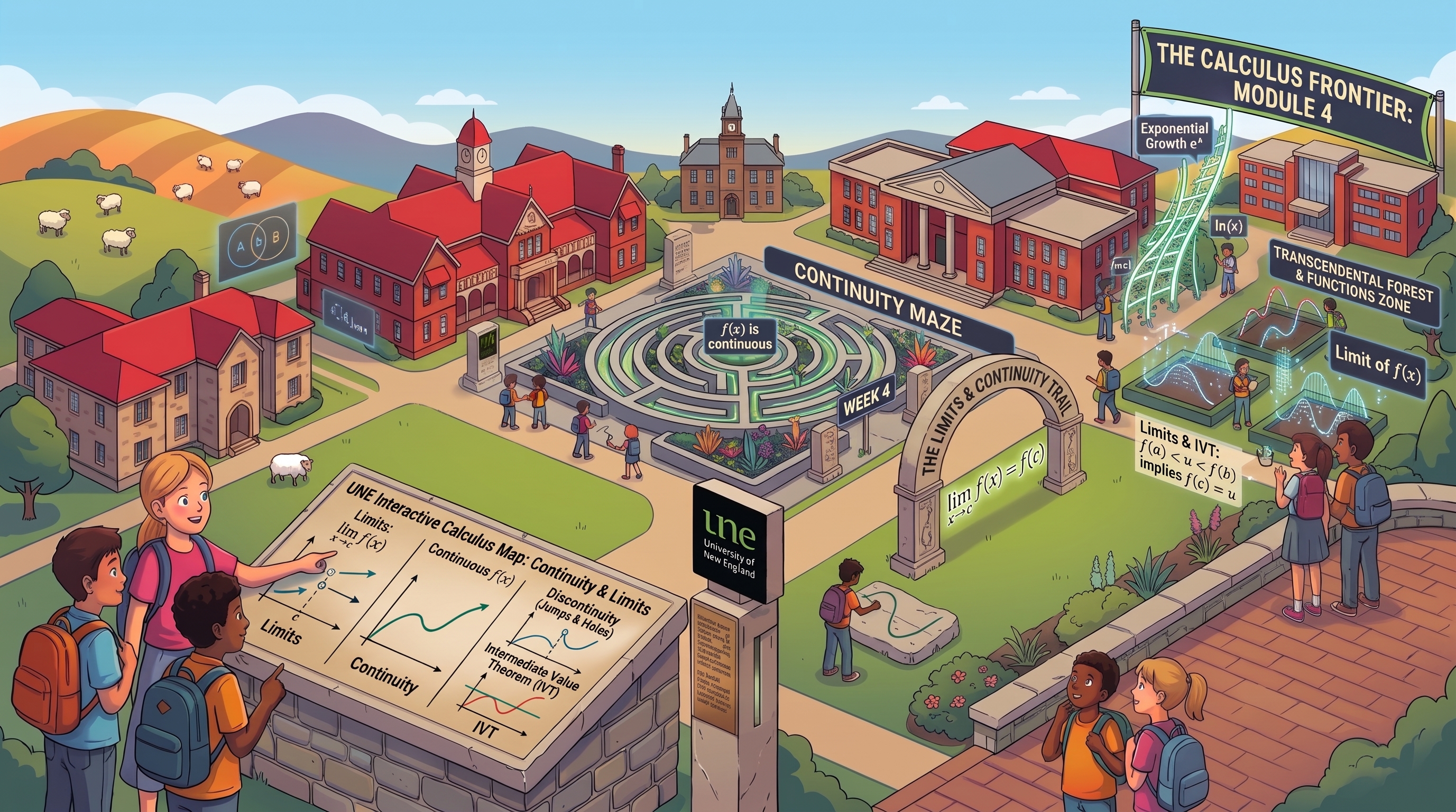
Welcome to Week 4: The Calculus Frontier
Up until this point, mathematics has been a study of static states. You've evaluated functions at specific, fixed inputs and solved algebra for exact answers. But what happens when an input is strictly forbidden—like dividing by zero—yet we desperately need to know how the system behaves right next to it?
This week, we cross the boundary into dynamic mathematics. We introduce the Limit, master rigorous Continuity ($\epsilon\text{-}\delta$), explore the Intermediate Value Theorem (IVT), and analyze long-term behavior at infinity with Asymptotes.
The Big Picture: Navigating Limits, Continuity & Asymptotes
Lecture 9 (Continuity of Functions) dives into the core mechanics of unbroken curves. We explore error control through a factory machine analogy, set up the rigorous four-clause $\epsilon\text{-}\delta$ formal definition, analyze jump discontinuity jailbreaks, and master the Intermediate Value Theorem with root-finding applications.
In Lecture 10 (The Limit of a Function), we step back to formalize the notation $\lim_{x \to c} f(x)$. We look at left-hand and right-hand limits, removable discontinuities (holes), and algebraic techniques to evaluate indeterminate forms like $\frac{0}{0}$.
In Lecture 11 (Limits at Infinity & Asymptotes), we look at the far horizons of the coordinate plane. We use limits to formally identify horizontal and vertical asymptotes, tracking the ultimate end-behavior of rational and transcendental functions.
🔍 Heads Up: Quiz 2 Approaching
Your next milestone is Quiz 2 at the end of Week 4. It will focus entirely on evaluating limits, mastering epsilon-delta continuity, identifying discontinuities, and applying the Intermediate Value Theorem.
The Ghost of 0/0, Unbroken Curves, and Asymptotic Horizons
How do we calculate behavior near forbidden points? We explore the historical crisis of dividing zero by zero, epsilon-delta fences, and how limits conquer infinity.
Weekly Lecture Modules
Select a lecture module below to begin:
Continuity of Functions & The IVT →
Master the formal $\epsilon\text{-}\delta$ definition of continuity, analyze discontinuity jump jailbreaks, and explore the power of the Intermediate Value Theorem for root-finding.
The Limit of a Function →
Explore the foundation of calculus. Track function destinations from left and right, bridge holes, evaluate algebraic indeterminate forms, and master direct substitution limits.
Limits at Infinity & Asymptotes →
Investigate long-term end behavior. Cast limits out to positive and negative infinity to rigorously define horizontal and vertical asymptotes.