Week 3 Overview Hub
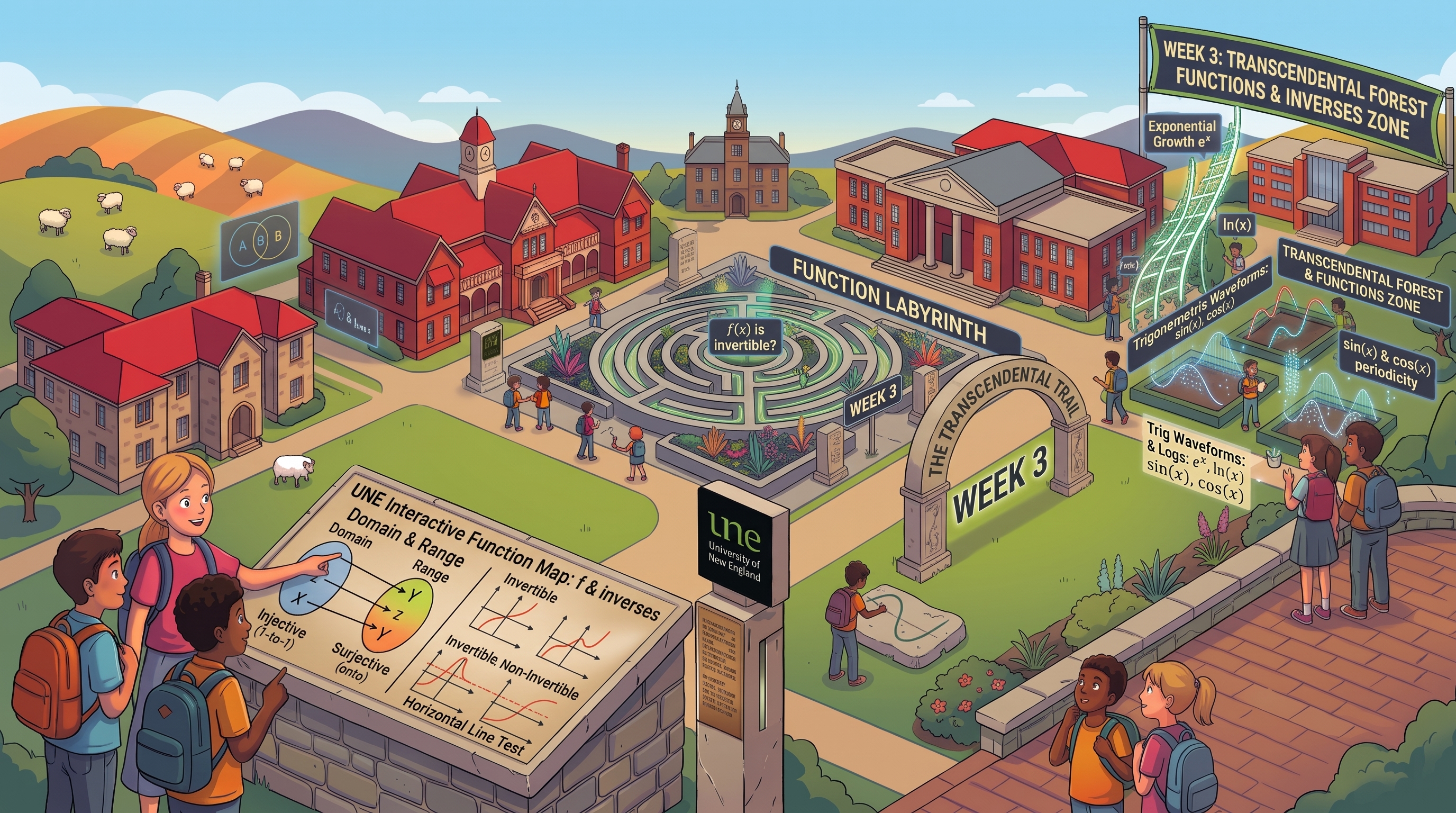
Welcome to Week 3: From Stepping Stones to Fluid Motion
Over the past two weeks, you've conquered the discrete world. You looked at sequences as stepping stones, examining what happens as you jump from step $n$ to step $n+1$, and built powerful logical tools to trap limits at infinity. You have proven that you can handle the rigorous mechanics of real analysis.
Now, we shift gears. Instead of isolated points, we step into the continuous world of Functions. This week is all about mapping inputs to outputs in a fluid, connected way. We will look at how curves behave and how special functions (like logarithms and exponentials) stretch and compress numbers.
The Big Picture: Mapping the Continuum
If a sequence is a flipbook of individual snapshots, a function is a seamless movie.
In Lecture 7 (Functions), we lay the groundwork. We revisit domains and ranges, but with a more critical eye. We explore what it takes for a function to be reversible (injective and surjective properties) and look at the geometry behind inverse functions. This is the structural foundation you need before we bend these curves.
In Lecture 8 (Transcendental Functions), we step outside the algebraic sandbox of polynomials. We tackle exponential growth, demystify the natural logarithm (why does $e$ keep showing up?), and review the periodic, oscillating nature of trigonometric functions. You will see how to define functions that algebra alone cannot capture.
📝 Assessment Reminder: Assignment 1
Assignment 1 (Worth 4%) is scheduled for this week. This is a mandatory ("must complete") assessment covering mathematical calculations and problem-solving for Topics 1-3. Please head over to the Assessments section in myLearn to check the specific due date and submission requirements.
The Anatomy of Unbroken Curves
Join us as we explore the transition from discrete sequences to continuous functions. We discuss what makes a function "transcendental", why invertibility matters in the real world, and how to model the cycles and curves of nature before stepping into differential calculus.
Weekly Lecture Modules
Select a lecture module below to begin:
Functions, Domains, and Inverses →
Transition from sequences to continuous mappings. We review domains, ranges, injective and surjective properties, and the mechanics of inverse functions, laying the groundwork for continuous mathematics.
Transcendental Functions →
Dive into non-algebraic territories. We formally define exponential growth, demystify natural logarithms, and review the foundational properties of trigonometric functions and their inverses.